
Introduction
Investing in an established business can provide access to an existing customer base, operating infrastructure, employees, and market presence. However, the information presented by a business owner does not always provide a complete picture of the company's actual condition.
Hidden liabilities, weak internal controls, customer concentration, ownership complications, operational inefficiencies, and compliance gaps can all affect the value and future performance of an investment.
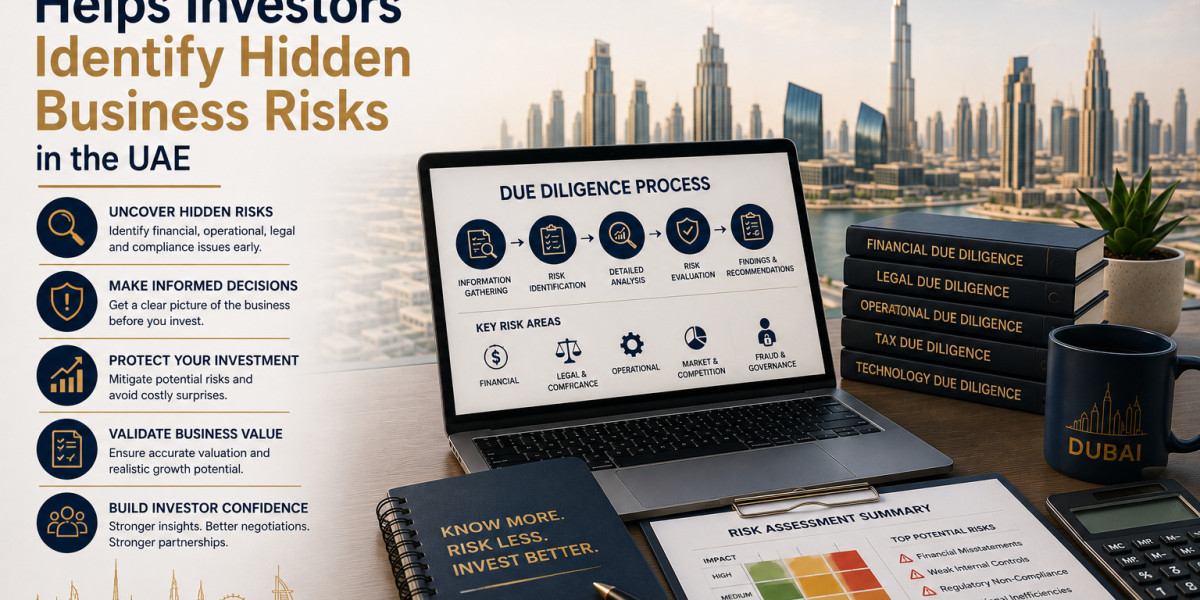
This is why due diligence for investors in UAE is an important part of evaluating a business before committing capital. A structured due diligence process allows investors to verify information, investigate potential risks, and understand whether the opportunity matches their expectations.
Rather than focusing only on profitability, investors can use due diligence to examine the underlying factors that determine whether a business is sustainable and capable of delivering long-term value.
What Are Hidden Business Risks?
Hidden business risks are issues that may not be immediately visible when an investor first evaluates a company.
They can exist in areas such as:
- Financial records
- Ownership structures
- Commercial contracts
- Tax and regulatory compliance
- Customer relationships
- Supplier arrangements
- Employee dependencies
- Technology systems
- Litigation
- Operational processes
- Debt and other liabilities
Some risks may have little impact on the transaction, while others can materially affect the company's valuation or future operations.
Due diligence helps bring these issues to the surface before the investor makes a final decision.
Why Investors Should Conduct Due Diligence in the UAE
The UAE has a diverse business environment containing mainland companies, free zone entities, regulated businesses, family-owned companies, international structures, and businesses with cross-border operations.
This means investors cannot rely on a single standard review for every transaction.
The UAE Government provides official digital business services, including access to the National Economic Register, which can be used as an initial source for checking business information. (u.ae)
A deeper due diligence review is then needed to determine whether the information available publicly and the information supplied by the target company are consistent.
1. Uncovering Financial Risks
Financial statements can provide useful information about a company's performance, but investors should examine the underlying records rather than relying only on reported revenue and profit.
Financial due diligence may examine:
- Revenue trends
- Cash flow
- Accounts receivable
- Accounts payable
- Bank balances
- Loans
- Fixed assets
- Inventory
- Major expenses
- Related-party transactions
Investors should look for unexplained transactions, unusual revenue patterns, significant outstanding receivables, or liabilities that could affect the company's financial position.
A business that appears profitable on paper may have cash-flow challenges that become apparent only after examining its supporting financial records.
2. Identifying Undisclosed Liabilities
One of the most important objectives of due diligence is identifying obligations that could affect the investor after the transaction.
Potential liabilities may include:
- Bank financing
- Supplier debts
- Tax obligations
- Lease commitments
- Employee-related claims
- Guarantees
- Contractual obligations
- Regulatory penalties
- Legal claims
Investors should establish which liabilities exist, whether they have been fully disclosed, and how they may affect the transaction.
Undisclosed obligations can change the effective value of a business and may also influence the structure of the deal.
3. Examining Ownership and Control
Ownership is another area where hidden risks can arise.
Investors should verify:
- Shareholders
- Ownership percentages
- Beneficial owners
- Persons exercising control
- Shareholder agreements
- Previous ownership transfers
- Corporate relationships
UAE beneficial ownership rules require relevant legal persons to maintain adequate, accurate, and up-to-date beneficial ownership information. The regulations also establish criteria for identifying beneficial owners based on ownership or control. (moec.gov.ae)
An unclear ownership structure should therefore be investigated carefully before an investment proceeds.
4. Finding Contractual Risks
Contracts can significantly influence a company's future revenue and operations.
Investors should review major agreements with:
- Customers
- Suppliers
- Employees
- Landlords
- Distributors
- Franchise partners
- Technology providers
- Financing institutions
Particular attention should be given to termination rights, renewal conditions, assignment restrictions, exclusivity clauses, and change-of-control provisions.
For instance, an important customer relationship may not provide the expected value if the contract can be terminated when ownership changes.
5. Detecting Customer Concentration Risks
A company's revenue may appear strong while depending heavily on a small number of customers.
Investors should determine:
- Who the largest customers are
- What percentage of revenue they represent
- How long the relationships have existed
- Whether agreements are formalized
- Whether customers are recurring or project-based
- How easily customers could move to competitors
High customer concentration does not automatically make a business unattractive, but it represents a risk that should be reflected in the investment assessment.
6. Identifying Supplier and Supply Chain Risks
Supplier dependency can create another hidden vulnerability.
A company may rely heavily on one supplier, country, distributor, manufacturer, or logistics provider. If that relationship is disrupted, the business may experience increased costs or difficulty fulfilling customer orders.
Due diligence should therefore assess:
- Major suppliers
- Supplier concentration
- Contract terms
- Alternative suppliers
- Pricing arrangements
- Import dependencies
- Supply interruption history
Understanding these factors can help investors assess the resilience of the company's operating model.
7. Assessing Operational Weaknesses
Some risks become visible only when investors examine how a business actually operates.
Operational due diligence may review:
- Internal processes
- Procurement
- Inventory management
- Customer service
- Technology systems
- Financial controls
- Reporting procedures
- Business continuity
- Employee responsibilities
Poorly documented processes or excessive dependence on manual work can create inefficiencies and make future expansion more difficult.
Investors should determine whether existing operations can support the company's expected growth.
8. Reviewing Tax and Compliance Exposure
Tax and regulatory compliance should also form part of an investor's risk assessment.
Depending on the business, investors may need to examine:
- VAT registration and filings
- Corporate tax obligations
- Tax records
- Trade licences
- Regulatory approvals
- Compliance filings
- Previous notices or penalties
The review should be tailored to the company's structure and activities.
A compliance issue that appears minor during negotiations can potentially create additional costs or administrative requirements after an investment.
9. Checking Litigation and Disputes
Existing or potential disputes can create financial and reputational risks.
Investors should determine whether the company is involved in:
- Commercial disputes
- Court proceedings
- Arbitration
- Employment claims
- Customer disputes
- Supplier disagreements
- Regulatory investigations
The important question is not simply whether litigation exists. Investors should understand the nature of the dispute, potential exposure, and whether it could affect business operations.
10. Identifying Management and Employee Dependencies
A company may rely heavily on a founder, senior manager, or small group of employees.
This creates a potential continuity risk if critical individuals leave after the transaction.
Investors should examine:
- Management structure
- Key employee responsibilities
- Employee turnover
- Critical skills
- Employment agreements
- Succession arrangements
- Founder dependency
The more dependent a business is on a small number of individuals, the more carefully investors should consider continuity planning.
11. Investigating Technology and Data Risks
Technology problems can create significant operational challenges.
Investors should assess whether the company's systems are:
- Reliable
- Scalable
- Properly integrated
- Adequately protected
- Supported by appropriate controls
They should also consider whether the business relies on outdated software or manual processes that could require substantial investment after the transaction.
For technology-dependent businesses, data management and cybersecurity should receive particular attention.
12. Examining Intellectual Property and Assets
Intellectual property and physical assets can form an important part of a company's value.
Investors should verify ownership and documentation relating to:
- Trademarks
- Copyrights
- Patents
- Domain names
- Software
- Equipment
- Vehicles
- Inventory
- Other significant business assets
It is important to confirm that valuable assets actually belong to the target company and are not owned personally by founders, shareholders, or related entities.
How Due Diligence Helps Investors Make Better Decisions
The value of due diligence extends beyond identifying problems.
Once risks have been identified, investors can assess their potential impact and determine whether they can be managed.
The findings may help investors:
- Negotiate the purchase price
- Request additional warranties
- Require specific issues to be resolved
- Modify the transaction structure
- Plan post-investment improvements
- Estimate future costs
- Decide whether the risk is acceptable
- Walk away from a transaction when necessary
This makes due diligence a decision-making tool rather than simply a document-review exercise.
Common Red Flags Investors Should Not Ignore
Some warning signs deserve immediate attention.
Inconsistent Information
Differences between corporate documents, financial records, and information provided by management should be investigated.
Unexplained Transactions
Large or unusual transactions without adequate supporting documentation may require further review.
Complex Ownership
Unclear control structures or unexplained relationships between companies can create additional risk.
Heavy Customer Dependence
Significant reliance on one or two customers may make future revenue vulnerable.
Weak Internal Controls
Poor approval processes and inadequate segregation of responsibilities can increase operational and financial risk.
Undisclosed Obligations
Loans, disputes, guarantees, or other commitments that were not initially disclosed can affect the true value of an investment.
Due Diligence for Different Types of UAE Investments
The scope of due diligence should change according to the investment.
Business Acquisition
An acquisition generally requires a broad review covering financial, legal, commercial, operational, tax, and compliance matters.
Partnership
For a partnership, investors may place greater emphasis on ownership, management responsibilities, financial contributions, decision-making authority, and exit arrangements.
Minority Investment
A minority investor should pay particular attention to shareholder rights, access to information, voting arrangements, dividend policies, and protections available to minority shareholders.
Strategic Investment
Strategic investors may need to focus on operational compatibility, technology, intellectual property, customers, supply chains, and potential synergies.
A Practical Risk Assessment Approach
After completing due diligence, investors can classify identified risks according to their potential impact.
Critical risks: Issues that could threaten the viability of the transaction or business.
High risks: Significant concerns requiring corrective action or additional protections.
Moderate risks: Issues that can potentially be managed after the transaction.
Low risks: Minor concerns that are unlikely to materially affect the investment.
This approach allows investors to distinguish between manageable weaknesses and risks that could fundamentally change the attractiveness of the deal.
Conclusion
Investors rarely have complete visibility into a business simply by reviewing its financial performance or speaking with its management. Important risks can exist within contracts, ownership structures, operations, compliance processes, customer relationships, and liabilities.
Effective due diligence for investors in UAE helps uncover these issues before they become expensive surprises. By systematically reviewing the company's financial, legal, commercial, operational, and compliance position, investors can better understand both the opportunity and the risks involved.
For investors evaluating businesses in Dubai and across the UAE, professional advisory support from firms such as Dubai Business and Tax Advisors (DBTA) can help bring together the different elements of the review and provide a more structured foundation for important investment decisions.


