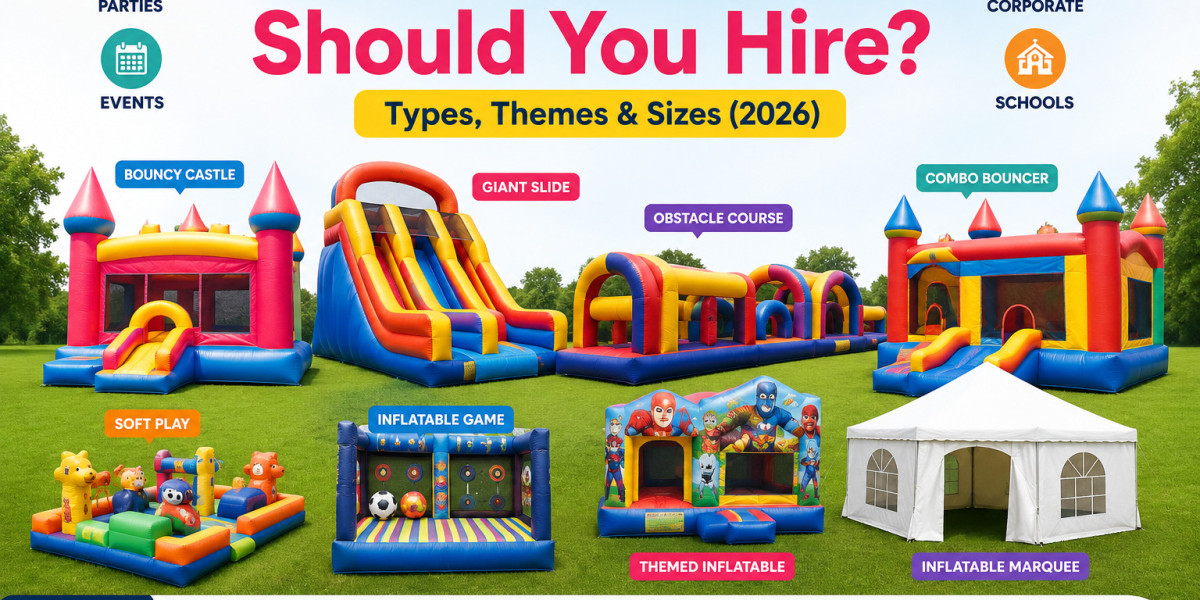

Choosing an inflatable looks straightforward until you compare options. Castles, slides, obstacle courses, interactive games, themed units and toddler equipment all sit on the same supplier page, and photographs give little sense of which suits a garden birthday versus a school field.
The decision comes down to four things: who is using it, how many, where you are putting it, and what you want the event to feel like.
This guide covers the main types available for inflatable hire, how to pick a theme, what size you actually need, and which options suit different events and age groups.
Which Inflatable Should You Hire?
Start with your guests rather than the equipment. A unit rated for under-eights will disappoint a party of eleven-year-olds, and an assault course built for teenagers is unsuitable for toddlers.
Then work through:
- Age range — the full spread attending, not just the birthday child
- Number of users — capacity limits determine how many can play at once
- Available space — measured, including clearance and access
- Venue type — indoor and outdoor impose different constraints
- Event style — a themed children's party and a corporate fun day want different things
- Budget — which sets the realistic size and number of units
Choosing on appearance is the most common error. A striking unit that will not fit your gate is worse than a plain one that will.
Popular Types of Inflatables to Hire in 2026
Bouncy castles
Enclosed bouncing areas with walled sides and a front step — the most familiar option and still the most booked. Best for younger children at birthdays, nursery events and garden parties, with modest space requirements compared with slides or courses. The benefit is simplicity: no instructions, and children know exactly what to do.
Inflatable slides
Slides bring height and visual presence, from garden-sized units to substantial multi-lane attractions. Suited to a wide age range depending on the unit, and popular at fun days and fetes, though they need significant space and height clearance, which rules most out indoors. Their benefit is drawing power — a slide is visible across a field.
Obstacle courses
Enclosed courses combining climbs, tunnels, squeezes and a slide, with users racing through. Best for older children, teenagers and adults at school events and fun days. Typically long and narrow, so measure length carefully. The benefit is repeat engagement — people queue for another attempt in a way they rarely do with a static unit.
Assault courses
Larger and more demanding than standard obstacle courses, often with multiple lanes for head-to-head racing. Suited to teenagers and adults at corporate events, festivals and larger community days, needing substantial space and good access. The racing format generates spectators as well as participants.
Interactive inflatable games
Units built around a specific challenge: penalty shootouts, target games, bungee runs, gladiator duels. Best for older children and adults at corporate events, fundraisers and parties, with small footprints that suit limited space. Many record scores, supporting leaderboards across a day.
Themed inflatables
Standard units decorated around a specific theme, from castles to jungle and space designs. Aimed at younger children's parties where a theme runs through the whole event, with space needs matching the equivalent plain unit. The benefit is coherence — entertainment and party feel like one thing rather than two.
Toddler-friendly inflatables
Smaller units with low platform heights, soft play elements, ball pools and gentle features, designed for pre-school children. Essential at family events where very young children would be unsafe on a standard castle, with a small footprint often suitable indoors. Without one, toddlers have nothing.
Larger inflatables for mixed-age events
Combination units and larger multi-element attractions serving a broad age range at once. Suited to school fairs, community events and family fun days, needing considerable space and often more than one supervisor. The benefit is throughput, handling more people than several small units in the same footprint.
| Inflatable type | Best for | Typical age suitability | Space needed | Key benefit |
|---|---|---|---|---|
| Bouncy castle | Birthdays, garden parties | Younger children | Modest | Simple and familiar |
| Slide | Fun days, fetes | Varies widely by unit | Large, with height | Visual drawing power |
| Obstacle course | School events, older children | Older children upwards | Long footprint | Repeat engagement |
| Assault course | Corporate, festivals | Teenagers and adults | Substantial | Head-to-head competition |
| Interactive games | Fundraisers, corporate | Older children, adults | Small | Fits limited space |
| Themed unit | Themed children's parties | Younger children | Modest | Ties the party together |
| Toddler unit | Family events | Pre-school | Small | Safe option for the youngest |
| Large combination | School fairs, fun days | Mixed ages | Large | High throughput |
Dimensions and age ratings vary between suppliers and individual units, so confirm the specifications for anything you are considering.
How to Choose the Right Inflatable Theme
Themes matter most for younger children, where a coordinated party has genuine appeal, and matter very little for corporate and community events.
Popular options include:
- Princess and unicorn — perennially popular with younger children, and easy to match with decorations
- Superhero — broad appeal across primary ages, and works for mixed groups of boys and girls
- Dinosaur — reliably popular with children roughly four to eight
- Jungle and safari — colourful and age-neutral, useful where you want something not tied to a character
- Football and sports — suits older children and works well at school and community events
- Pirate — versatile, and pairs naturally with treasure hunts and other activities
- Space — less common, which is often the appeal
- Seasonal — Christmas, Halloween and summer designs for events built around a date
Three practical points. Popular themed units book up first, so enquire early if a specific design matters. Availability varies between suppliers, since themed stock is more limited than plain equipment. And for mixed-age events, a neutral design usually works better than one aimed at a narrow group.
If a specific theme is unavailable, decorations plus a plain unit often achieve the same effect for less.
What Size Inflatable Do You Need?
Here is the point most people miss: the advertised dimensions are not the space you need.
A unit's stated size covers the inflated footprint only. In practice you also need:
- Safety clearance on all sides, specified by the supplier
- Room for anchor ropes, which extend beyond the footprint and need securing
- Space for the blower, which sits outside the unit and needs a clear run to a power supply
- A queuing area in front of the entrance
- Room for supervision, so an adult can stand where they can see properly
Measure and check:
- Floor space, in both directions, at the actual setup position
- Ceiling height for indoor venues, which is the most common reason a booking falls through
- Access points along the whole route from where a vehicle can park
- Doorways and gates, particularly the narrowest point
- Pathways, including corners, steps and level changes
- Surface, since grass allows ground stakes while hard surfaces need ballast
Take your own measurements and give them to the supplier. It is a short conversation that prevents a wasted delivery.
Indoor vs Outdoor Inflatable Hire
Space and ceiling height. Outdoor sites rarely constrain size. Indoors, height is usually the limiting factor and rules out slides and taller courses in most halls.
Weather. The main outdoor consideration. No inflatable should be used in winds above 24 mph, and some units carry a lower manufacturer limit, so outdoor hires depend on conditions on the day.
Surface and anchoring. Grass allows ground stakes; hard surfaces require ballast. Indoors, anchoring still applies per the operator's manual, since a unit needs securing against movement and overturning as well as wind.
Ventilation and access. Indoor spaces warm up quickly with active inflatables, and the full route including doorways, corridors and lifts needs checking.
Venue rules. Schools and hired halls frequently set their own requirements, including evidence of insurance.
Which Inflatables Are Best for Different Events?
Birthday parties. A castle or themed unit sized to the age group, with a toddler unit added where younger siblings attend.
School events. Combination units or a castle plus an obstacle course, zoned by age. Throughput matters more than novelty at a summer fair.
Weddings. A modest unit in a designated area keeps children occupied during the reception. Position it well away from the ceremony and speeches.
Corporate events. Assault courses and interactive challenges rated for adults. Team formats with timed runs work better than free play.
Community events. Broad-appeal units with visual presence to draw a crowd, ideally covering more than one age band.
Festivals. Large attractions built for sustained footfall, with multi-day arrangements, generator power and staffing rotas to consider.
Family fun days. A mix rather than a single unit — something for toddlers, something for older children, and ideally something adults can join.
Which Inflatables Are Suitable for Different Ages?
Toddlers need dedicated units with low platform heights and soft play features. Standard castles are generally unsuitable, and mixing toddlers with older children causes many minor injuries.
Young children are well served by standard castles and themed units, with supervision throughout. Older children need more challenge, since a basic castle is outgrown quickly. Teenagers respond to competition: assault courses, head-to-head games, timed challenges. Adults need adult-rated equipment, which differs in construction, dimensions and weight ratings.
Mixed-age groups are best served by zoning, using separate units or rotating age groups on a timetable.
Always follow the manufacturer's guidance on age, height, weight and occupancy limits for the specific unit, and ask your supplier if anything is unclear.
How Much Does Inflatable Hire Cost?
Prices vary too widely for a meaningful figure, and any guide quoting one is guessing. The factors that drive a quote:
- Type and size of the unit
- Hire duration, from a few hours to a full day
- Delivery distance from the supplier's base
- Installation requirements, including difficult access
- Collection timing, particularly late finishes
- Venue, since some sites need extra equipment or matting
- Date — summer weekends, school holidays and December carry premium rates
- Additional equipment such as generators or extra units
- Package deals, where booking several attractions together
Prices differ by supplier, location, date and equipment, so request written quotes and compare what each includes rather than the headline figure.
What Should You Check Before Booking an Inflatable?
- Exact dimensions and required clearance
- Age, height and occupancy limits for the specific unit
- Safety information, including inspection documentation
- Delivery, installation and collection times, confirmed in writing
- Public liability insurance, with evidence if your venue requires it
- Equipment condition and how units are cleaned between hires
- Weather policy for outdoor bookings
- Cancellation policy and any deposit terms
- Access requirements along the full route
- Ground conditions and the anchoring method to be used
- Power requirements, and whether a generator is needed
Inflatable Hire Safety Checklist
☐ Inspection documentation confirmed (PIPA tag or ADIPS Declaration of Compliance, showing BS EN 14960 conformity) ☐ Public liability insurance confirmed ☐ Unit anchored correctly for the surface, using all anchor points ☐ Wind conditions monitored throughout, with 24 mph the absolute upper limit ☐ Constant supervision by a nominated adult ☐ Occupancy, age and height limits observed ☐ Shoes, glasses and pocket contents removed before use ☐ Access and exit points kept clear ☐ Manufacturer's operating instructions followed ☐ Use stopped immediately if conditions become unsafe
How to Get the Most From Your Inflatable Hire
Position it deliberately. Visible from the entrance, with room for a queue that does not block a path, gate or food area.
Leave proper clearance. Guests gather to watch, so allow more space than the unit alone occupies.
Start it early. An empty inflatable stays empty while a busy one draws a crowd.
Combine with other entertainment. An inflatable plus face painting or a party entertainer covers more of the guest list than either alone.
Plan supervision properly. Nominate specific adults and brief them on capacity and age limits rather than assuming someone will step in.
Schedule breaks, particularly in summer, with drinks and shade near the queuing area.
Frequently Asked Questions About Inflatable Hire
What is included with inflatable hire? Typically the unit, blower, safety mats, delivery, setup and collection. Supervision may or may not be included, and generators are often extra. Confirm the scope in writing before booking.
How much space do I need for an inflatable? More than the advertised dimensions. You need the footprint plus safety clearance, room for anchor ropes and the blower, a queuing area and space to supervise. Request exact figures from your supplier.
Which inflatable is best for a children's birthday party? A standard or themed bouncy castle sized to the age group, with a toddler unit added if younger siblings are attending. Check the age rating covers your youngest guests.
Are inflatables suitable for indoor events? Many are, though ceiling height usually determines what fits and rules out slides and taller courses in most halls. Anchoring still applies indoors, and some venues require insurance evidence.
What age are bouncy castles suitable for? It varies by unit, with dedicated toddler equipment for pre-school children and standard castles for older ones. Always follow the manufacturer's stated age, height and weight limits rather than assuming.
Can I hire an inflatable for a school or corporate event? Yes, and both are common. Schools usually require insurance evidence and complete their own risk assessment. Corporate events generally suit adult-rated units such as assault courses and competitive games.
How long can I hire an inflatable for? Most hires cover a few hours or a full day, with multi-day arrangements available for festivals. Confirm whether setup and collection sit inside or outside the hire window.
What happens if it rains? Light rain is often workable, but wind is the safety issue and no inflatable operates above 24 mph. Suppliers may close or cancel on safety grounds, so read the weather policy before booking.
Do inflatable hire companies deliver and set up the equipment? Most do, covering delivery, positioning, inflation, anchoring, safety checks and collection. Arrangements differ, so confirm what is included.
How far in advance should I book an inflatable? As soon as your date and venue are settled. Summer weekends, school holidays and popular themed units go early, and booking ahead gives a better choice.
Choosing Well
The right inflatable is the one matched to your guests, your space and your event, not the one that photographs best.
Work through it in order: establish the age range and numbers attending, measure your space including access and height, decide indoor or outdoor, then choose type and theme within those limits. Confirm age and occupancy ratings, check the safety documentation and read the weather policy before committing.
If you are unsure what would suit, contact a local inflatable hire company with your guest numbers, ages and venue measurements to hand.


