
Introduction
Email remains an important channel for organizations selling products, services, technology, databases, educational resources, and professional solutions to libraries. But campaign success depends on more than the size of a Librarian Email List. Response rates reveal whether the audience is relevant, the message is useful, and the contact data is sufficiently accurate.
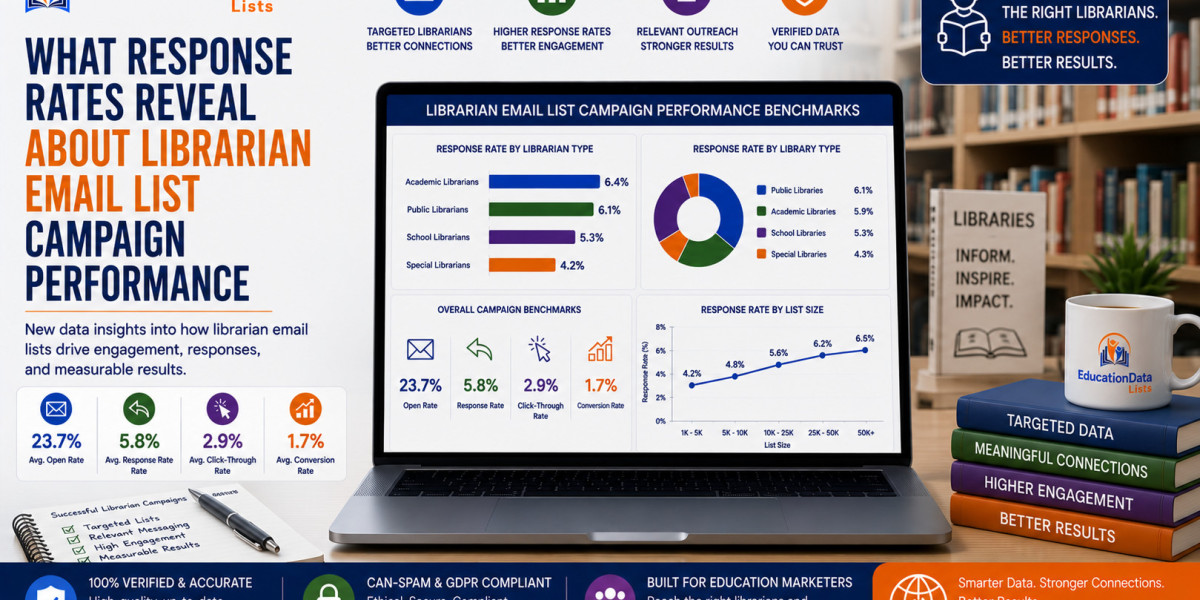
The latest library-specific benchmark provides a valuable reference point. EBSCO's 2025 Library Email Marketing Benchmarks Annual Report analyzed more than 377,000 emails sent to over 166 million subscribers between July 2024 and June 2025 through LibraryAware. The study reported a 49.67% average open rate, 2.24% average click-to-open rate, 0.46% bounce rate, and 0.98% unsubscribe rate.
These numbers provide a useful framework for evaluating librarian-focused campaigns and identifying where performance can improve.
What Do Current Library Email Benchmarks Reveal?
The most important finding is that library email audiences can show substantially stronger email visibility than broad industry averages.
EBSCO's 2025 benchmark reported:
| Metric | 2025 Library Benchmark |
|---|---|
| Average open rate | 49.67% |
| Average click-to-open rate | 2.24% |
| Average list growth rate | 11.03% |
| Average bounce rate | 0.46% |
| Average unsubscribe rate | 0.98% |
The data covers a very large sample, making it one of the most relevant recent benchmarks available specifically for the library sector.
For marketers, the key takeaway is that opens alone do not tell the complete story.
A campaign can achieve a strong open rate because the subject line attracts attention, yet generate relatively few clicks if the content does not provide enough value.
That is why response analysis should move from:
Open → Click → Reply → Conversion
rather than stopping at the open.
Why Librarian Email Engagement Requires Precise Targeting
Libraries are not a single business category. They include public, academic, school, special, government, and research-oriented institutions, each with different operational requirements.
The Institute of Museum and Library Services maintains the Public Libraries Survey, an annual data collection program that has operated since 1988. Its datasets include information that researchers and organizations can use to understand public-library characteristics and operations.
For B2B marketers, this diversity means that a broad Librarian Mailing List may not automatically produce strong response rates.
A campaign aimed at an academic librarian might emphasize:
Research databases
Scholarly content
Discovery tools
Interlibrary services
A public-library campaign could instead focus on:
Community programming
Digital literacy
Patron engagement
Public-access technology
The more closely the offer matches the librarian's environment, the greater the potential for meaningful engagement.
How Should Marketers Interpret a 49.67% Open Rate?
The 49.67% library benchmark is encouraging, but marketers should not treat it as a guaranteed target for every campaign.
EBSCO notes that its benchmark represents emails sent through LibraryAware to library subscribers. A vendor sending unsolicited B2B outreach to librarians is operating under different circumstances from a library emailing people who have already subscribed to its communications.
That distinction is critical.
Permission-based subscriber email and prospecting email should not be compared as if they were identical channels.
A marketing team using a Librarian Email Database should therefore establish its own baseline based on:
Audience source
Contact permission
Geography
Library type
Job role
Campaign objective
Message relevance
Sending frequency
The benchmark is best used as context rather than a promise.
Why Clicks Can Reveal More Than Opens
Open rates indicate that an email was registered as opened, but clicks provide a stronger indication that the recipient interacted with the content.
EBSCO's 2025 library benchmark reported a 2.24% average click-to-open rate. This means that, on average, 2.24% of recorded opens generated at least one click.
However, marketers must account for privacy-related measurement limitations.
Mailchimp explains that Apple Mail Privacy Protection and bot activity can artificially inflate open and click measurements. It recommends filtering such activity when possible.
Therefore, a sophisticated librarian campaign should track:
Delivery rate
Open rate
Click rate
Click-to-open rate
Reply rate
Meeting or inquiry rate
Qualified lead rate
Conversion rate
The later metrics are generally more closely connected to commercial outcomes.
What Does the 0.46% Bounce Rate Tell Marketers?
The 2025 LibraryAware benchmark reported an average 0.46% bounce rate.
Bounce rate is particularly important for organizations using a large external Librarian Email List.
A high bounce rate can indicate:
Outdated email addresses
Incorrect domains
Staff turnover
Duplicate records
Poor data collection
Inadequate verification
A low bounce rate does not guarantee engagement, but it establishes an important foundation.
If a marketer sends 10,000 messages and a significant percentage cannot reach their intended recipients, campaign efficiency suffers before subject lines or content are even evaluated.
Data quality should therefore be considered a campaign-performance variable, not simply an administrative concern.
Why Librarian Role Segmentation Matters
A librarian's professional role can significantly affect the relevance of a campaign.
Potential segments include:
Public Library Directors
Messages may focus on:
Budget efficiency
Community services
Staffing
Digital transformation
Academic Librarians
Relevant topics may include:
Research resources
Scholarly databases
Digital collections
Student services
School Librarians
Campaigns may emphasize:
Curriculum support
Student literacy
Educational technology
Teacher collaboration
Technical or Digital Services Librarians
Messages can focus on:
Systems integration
Metadata
Digital platforms
Automation
Technology infrastructure
Segmentation makes a Librarian Email List more useful because the campaign is organized around the recipient's responsibilities rather than simply the institution's name.
Personalization Can Strengthen Response Rates
Personalization should go beyond inserting a recipient's first name.
The goal is to demonstrate why the message is relevant to the recipient.
For example, instead of:
"We provide innovative solutions for libraries."
A campaign could say:
"Academic libraries managing expanding digital collections need discovery tools that make resources easier for students and researchers to find."
The second message communicates a specific problem.
EBSCO's 2025 benchmark recommends matching email content to community interests and monitoring how audiences respond to frequency and content. It also recommends keeping sender identity consistent so subscribers recognize the source.
For B2B marketers, these principles translate into role-based personalization and consistent sender identity.
Segmentation Has Demonstrated Measurable Impact
Evidence from adjacent education marketing also shows how segmentation can change campaign results.
In April 2026, Mailchimp reported that the Institute for Multi-Sensory Education achieved a 1.7× improvement in open rates and a threefold increase in click-through rate, with clicks reaching 6.9%. The organization had more than 505,000 contacts and achieved a 99.6% delivery rate. Mailchimp attributed the improvement to changes including audience management, segmentation, email structure, and personalization.
This is not a librarian-specific benchmark and does not prove that segmentation will produce the same improvement for every campaign.
It does, however, demonstrate an important principle:
Better audience relevance can materially change email engagement.
Library Technology Priorities Make Relevance Even More Important
Libraries are also operating in a rapidly changing technology environment.
OCLC's 2024–25 annual report describes increased investment in AI-powered workflows, digital delivery, discovery, cataloging, and resource sharing. OCLC reported that its AI-enhanced resource-sharing network saved library users an estimated 410,000 hours of waiting time and freed staff from more than 13,600 hours of processing time during FY2025.
This illustrates the kinds of operational changes taking place across the library sector.
For vendors marketing to librarians, generic messaging about "innovation" is unlikely to be as compelling as a specific explanation of how a solution can:
Save staff time
Improve discovery
Reduce administrative work
Enhance patron services
Improve digital access
Support data quality
Campaign relevance should follow the problems librarians are actually trying to solve.
5 Ways to Improve Librarian Email Campaign Response Rates
1. Segment by library type
Separate public, academic, school, special, and research libraries where possible. Different environments require different messaging.
2. Segment by job function
A library director and a technical-services librarian should not necessarily receive the same campaign.
3. Prioritize data accuracy
Verify professional titles, institutions, email addresses, and domains before launching campaigns. The 0.46% LibraryAware bounce benchmark provides a useful directional reference for deliverability.
4. Measure clicks and replies
Do not rely solely on open rates. Clicks, replies, inquiries, meetings, and qualified leads provide stronger evidence of campaign effectiveness.
5. Test frequency and subject lines
EBSCO recommends consistent sender identity, relevant content, strong subject lines, and monitoring how recipients respond to email frequency.
How EducationDataLists Can Support Librarian Outreach
A targeted Librarian Email Database can give marketers a structured starting point for reaching library professionals across relevant institutions.
EducationDataLists focuses on education-sector contact data and can be positioned as a resource for organizations seeking to identify librarian and education decision-maker audiences.
However, database size should not be the only purchasing criterion.
Marketers should evaluate:
Contact accuracy
Job-title relevance
Institution coverage
Geographic coverage
Update frequency
Segmentation capabilities
Suppression processes
The objective is to build a smaller, more relevant audience when that produces better campaign economics than simply maximizing contact volume.
What Does a Strong Response Rate Really Mean?
A strong response rate is ultimately relative to the campaign objective.
For a newsletter, the goal may be clicks and content consumption.
For a software vendor, the objective may be qualified product inquiries.
For a publisher, it could be subscriptions or resource requests.
For a professional-services company, the desired result might be a meeting.
Therefore, a marketer should define success before comparing campaign results with industry benchmarks.
A useful framework is:
Deliverability → Attention → Engagement → Response → Conversion → Revenue
Each stage answers a different question.
Deliverability: Did the message reach the recipient?
Attention: Did the subject line generate interest?
Engagement: Did the recipient interact?
Response: Did they reply or take a meaningful action?
Conversion: Did they become a qualified opportunity?
Revenue: Did the campaign generate measurable business value?
This framework provides a more complete picture of Librarian Email List performance than open rate alone.
Conclusion
The latest library-specific data provides a strong benchmark for marketers evaluating librarian email campaigns. EBSCO's 2025 Library Email Marketing Benchmarks Report analyzed more than 377,000 emails reaching over 166 million subscribers and found an average 49.67% open rate, 2.24% click-to-open rate, 0.46% bounce rate, and 0.98% unsubscribe rate.
However, these figures should be treated as directional benchmarks rather than guaranteed results for B2B prospecting. The strongest campaign performance comes from combining accurate contact data with segmentation, relevant content, consistent sender identity, and rigorous measurement.
For organizations using a Librarian Mailing List, the central lesson is simple: response rates are not just numbers. They are diagnostic signals. A high open rate can indicate effective positioning, while clicks and replies reveal whether the message actually motivates action. By analyzing every stage of the funnel, marketers can turn librarian outreach into a more measurable and repeatable growth channel.
Frequently Asked Questions
1. What is the average email open rate for libraries?
EBSCO's 2025 LibraryAware benchmark reported a 49.67% average open rate based on library email activity between July 2024 and June 2025. This is a library-specific benchmark and is more relevant to library communications than broad industry averages.
2. What is a good response rate for a Librarian Email List?
There is no universal librarian-specific response-rate target because results vary according to campaign type, audience source, permission status, offer, and job role. Marketers should establish their own baseline and compare performance with relevant benchmarks rather than applying one fixed number.
3. What is the average click-to-open rate for library emails?
EBSCO's 2025 Library Email Marketing Benchmarks Report recorded a 2.24% average click-to-open rate. Because privacy and automated activity can affect email measurement, marketers should also track actual replies, inquiries, and conversions.
4. Why does data quality affect librarian email campaign performance?
Incorrect or outdated addresses increase bounce rates and reduce the number of legitimate contacts receiving campaigns. Accurate job titles and institutional information also make segmentation and personalization more effective.
5. Should librarians be segmented by job title?
Yes. Library directors, academic librarians, school librarians, technical-services professionals, and digital-services specialists can have substantially different priorities. Role-based segmentation allows marketers to make the content more relevant to each audience.
6. What metrics should marketers track besides open rate?
Track delivery rate, click rate, click-to-open rate, replies, inquiries, meetings, qualified leads, conversions, and revenue. Open rates are useful but can be affected by privacy technologies such as Apple Mail Privacy Protection.
7. How can a Librarian Mailing List improve campaign performance?
A targeted list can reduce wasted outreach by helping marketers reach relevant library professionals rather than a broad, undifferentiated audience. Combining accurate contact information with role, institution, and geographic segmentation can make campaigns more relevant.
8. How often should marketers email librarians?
There is no universally optimal frequency. EBSCO recommends monitoring how audiences respond to frequency and adjusting based on engagement and unsubscribe behavior. Relevant content and consistent sender identity are also important for maintaining trust.


